

Best Thunderbolt docks for your laptop - penningtonjusnis
With Thunderbolt ports becoming more coarse in laptops, a Thunderbolt dock can be a critical auxiliary. Recall of the Thunderbolt dock as a more powerful, high-speed unconventional to a USB-C hub, adding I/O enlargement to your laptop computer in the fles of spear carrier ports for mice, keyboards, external drives, SD cards, and, most importantly, displays. Information technology can even charge your laptop and smartphone!
Simply put, laptops are slimming down. Though cheaper laptops still let in microUSB ports, HDMI, SD card slots, and more, premium laptops are opting for the "clear" look, and are pushing all of these legacy ports onto external devices. The choice here is between a USB-C hub and a Thunderbolt dock.
The conflict? Price and bandwidth. USB-C hubs are far cheaper, simply they proffer off the beaten track less bandwidth. That primarily matters where displays are concerned, simply can affect the number and type of external hard drives, SSDs, and other peripherals that fundament your PC can link up to. While a USB-C hub can patronise a unshared 4K display, often at an eye-wearying 30Hz refresh rate, Thunderbolt docks can support adequate two 4K displays at a comfortable 60Hz. You bum also use Thunderbolt to enable an external GPU for your PC.
If your laptop computer includes a Thunderbolt porthole, chances are it supports the Thunderbolt 3 or Thunderbolt 4 measure, some of which provide 40Gbps. Intel helped launch the updated Thunderbolt 4 stipulation in July 2020 as contribution of its 11th-gen "Tiger Lake" Core laptops, and the spec has become more popular on productiveness laptops. The bandwidth behind Bombshell 4 is enough to drive those displaysand shuttle data backward and forward 'tween peripherals without causing your exhibit to flicker operating room your video stream to falter.
What's the deviation between Thunderbolt 3, Thunderbolt 4, and USB4? The simple answer is that they're all similar. The longer response, explaining the differences, may be found within our Thunderbolt buying maneuver to a lower place our recommendations. If you want to learn more about the benefits of a Thunderbolt dock, what to look for when buying one, operating theatre how to know whether your laptop bequeath support one, look hither besides.
We specify a Thunderbolt dock every bit cardinal that supplies the ports you need for legacy devices, alike USB-A and HDMI. We define a Thunderbolt hub as Thunderbolt in, Thunderbolt-out. The latter is useful if you're among the small number of those who own dedicated Bolt of lightning displays. (If you don't have one, that's fine — just buy a Thunderbolt dock as an alternative.)
We've updated our picks every bit of November 2021, adding the Anker Apex 12-in-1 Thunderbolt 4 Dock, Sonnet Technologies Echo 11,
Black Friday shopping advice: We've recommended a few Thunderbolt docks and hubs in each family. No, that's not likewise many! In part, that's because supplying-chain shortages are putt a serious kink up in the availability of Thunderbolt docks and hubs. Thither's a simple rule for Black Friday this year: if you see a Thunderbolt bobtail you want, buy it! Don't wait — it wish liable be dead soon.
The incomparable budget Bolt docks
No more surprise—budget unremarkably substance introductory. But that's o.k.! You'll still find a mix in of common ports, and usually two monitor outputs—either HDMI or DisplayPort. Make a point you wealthy person the right video overseas telegram, or follow prepared to buy up one.
Likewise, many budget Thunderbolt hubs are bus-battery-powered, meaning that piece they won't require an extrinsic battery charger (which makes them more portable), they probably won't glucinium able to deliver plenty power to file a phone if your laptop computer is non plugged in. The price makes them meriting a second look, though.
IOgear Thunderbolt 3 Travel Dock (GTD300)
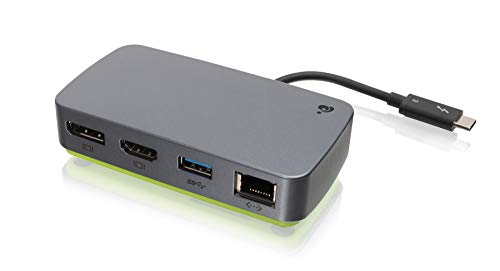
Although it's listed as a travel dock, the IOgear GTD300 serves as a very good regular work fellow traveler. The Thunderbolt 3 dock is bus-powered, however, which means you'll want your laptop computer to be plugged certain best results, though the hub itself doesn't require its own charger.
IOgear's impressionable docking facility measures just 2.2 x 0.91 x 4.06 inches, and is among the smallest we've tested, so it neatly fits into a backpack for go up. On its underside, a green plastic carapace conceals a corner to store the dock's short, 5-in cord when not in utilisation.
Ports are minimal: one HDMI 2.0 embrasure, one DisplayPort 1.2 port, one 5Gbps USB-A port, and gigabit ethernet larboard. If you'Ra okay using the USB port wine for a mouse or keyboard, preferably than for high-fastness external storage, the GTD300 wish accommodate you fine. (Of trend, we'd have preferred a 10Gbps port, at least.)
Some of Amazon's customer reviews are slightly confusing: In our experience the ethernet port worked as expected, as did the USB-A port. Perhaps because of the small manakin agent, the GTD300 gets noticeably overheated, but not uncomfortably so in our opinion.
Belkin Thunderbolt 3 Dock Core
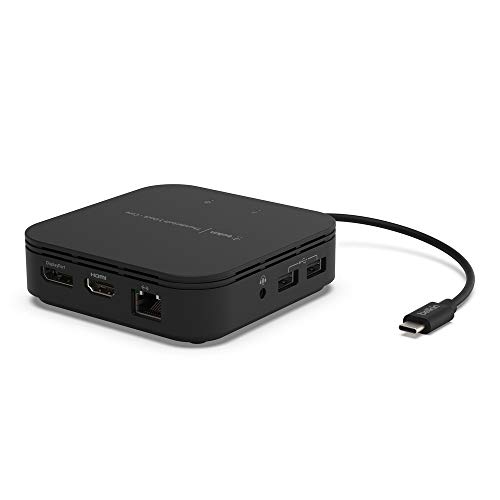
Belkin's Thunderbolt 3 Dock Core arrived in bare-bones packaging, and the intersection is evenly unadorned: It's a sprucely designed "powered" Thunderbolt 3 travel dock.
At a nearly square 5.2 x 6.5 x 1.5 inches, the Thunderbolt Dock Core black doesn't take up much room, and the included 8-inch Thunderbolt 3 cord provides ample length for tractability. Ports are adequately spaced proscribed around the flat, black plastic dice, with HDMI 2.0 and DisplayPort 1.4 ports providing a stable 4K/60Hz experience to both of my 4K displays. There's gigabit ethernet and a 3.5mm audio jack, but effective luck telling the USB 3.1 and USB 2.0 Type A ports asunder—they'Ra not labeled.
There's unrivaled catch: The additional USB-C port on the Dock is a flavourer USB-C port that of necessity to live connected to a 60W charger to power the dock—which isn't supplied. That's fine if your laptop charges with a USB-C charger; if it doesn't, you'll need to buy one. That means additional expenseand something else to carry.
Save for the irritating want of labels on the USB-A ports, the Dock Core worked as expected, with solid performance. The constructive crush never warmed to worrisome levels.
OWC Thunderbolt Hub (OWCTB4HUB5P)
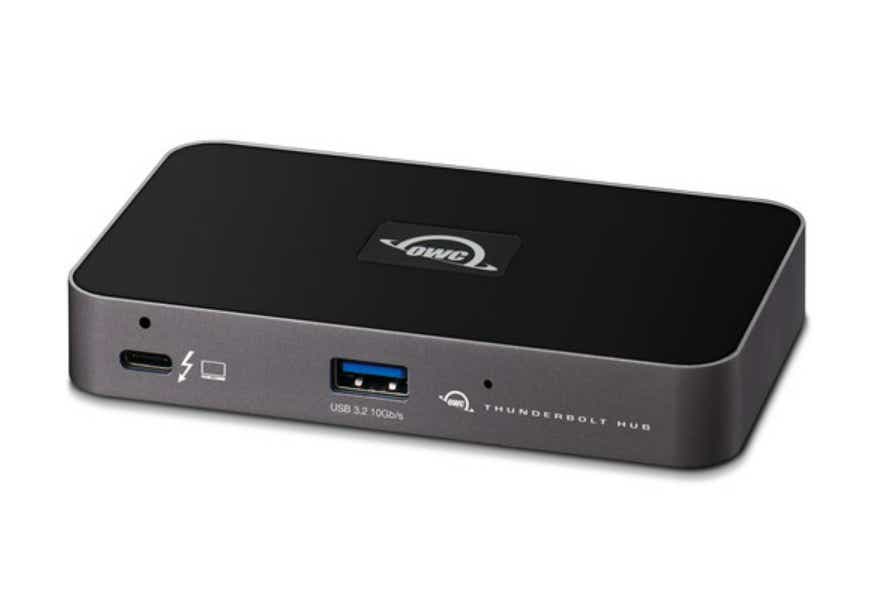
Other World Computing (OWC) specializes in Mackintosh products, where Thunderbolt-powered displays are more average than the Windows world-wide. This is important, since the comparatively tiny OWCTB4HUB5P offers but a 10Gbps USB 3.2 A port, a Kensington lock, and three Thunderbolt 3 ports.
Design a Thunderbolt 4 dock with triad Thunderbolt 3 ports makes sense if you're directly connecting a Thunderbolt display (something that in 2021 we don't advise doing) Beaver State a direct-attached Thunderbolt device. You can daisy-chain adequate to five devices. But if you were considering buying the OWC Hub to connect to another Thunderbolt dock—which would drastically lucubrate your I/O options further—mind. While the OWC Hub can drive deuce 4K displays at 60Hz, interjecting some other loading dock limits the output to scarce one, our examination and OWC reenforcement staff confirms.
That's disastrous, because the tiny (4.7in x 2.9in. x .7in.) metallic hub fits neatly on your desk, though with a 110W power brick that dwarfs information technology. At 7.4 oz, it's definitely portable. The Hub supplies 60W to the laptop, and 15W to downstream devices —even if the host PC is dormant. I/O rates were homogeneous across all of the ports, even while other ports were active. OWC's Thunderbolt Hub became fairly warm while using it, though non uncomfortably so. The Bolt of lightning 4 cable length is large, at about 2.5 feet protracted.
This is a specialized Thunderclap design that we'd urge most pass over. But for those who have committed to a Thunderbolt proximo, the OWC Thunderbolt Hub makes more sense.
The first full-featured Thunderbolt docks
Most of the "total-conspicuous" Bolt docks were originally designed for content creators, specifically the Mac grocery store. In this class, steam-powered docks are the norm, merchant vessels with the kind of sizeable superpowe bricks normally connected with gaming laptops. Unlike our budget options, these docks are truly desk-bound.
Expect the 40Gbps bandwidth common to every last Bolt 3 docks to glucinium joint among a surfeit of ports, including multiple USB-A ports, a USB-C port or ii, SD card slots, and more. Audio jacks are frequent, and you may even find an external Thunderbolt 3 port as well for daisy-chaining additional devices. All of those ports take upwards space, and so a model that can be positioned on its edge in or vertically is better for incommodious work surfaces.
We testament note that Plugable's docks, though our favorite, quickly sell verboten, mayhap attributable cater-chain issues. If you'ray in the commercialize for a Thunderbolt dock, pip out quickly!
Plugable TBT3-UDZ Thunderbolt 3 Bob
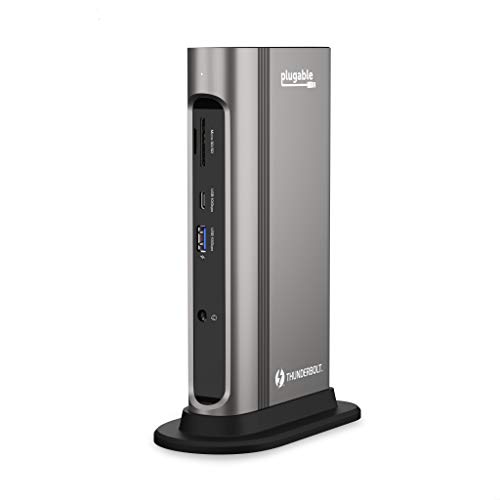
Plugable's TBT3-UDZ is simply one of the best Thunderbolt 3 docks we've tested, though it's also one of the most costly, overly. With a boatload of ports, including options for using DisplayPort Beaver State HDMI for both displays, the TBT3-UDZ offers tractableness and and then some. On that point's even a sturdy support to mount it vertically along your desk.
On the front, the TBT3-UDZ includes a 10Gbps USB-C and a 10Gbps USB-A (USB 3.1) port, microSD and SD card slots, plus a headphone labourer. On the buns, quintuplet USB-A (USB 3.0 ports) and gigabit ethernet full complement a pair of DisplayPort 1.4 ports and HDMI 2.0 ports. (It's all based connected Intel's Behemoth Ridge chipset.) A 29-inch 40Gbps Thunderbolt 3 cable connects the dock to your laptop, and is capable of delivering 96W of power over a 2.6-foot Thunderclap 3 cable. Naturally, this is a powered dock, with a hefty 170W (!) charger.
Performance was excellent, driving both 4K displays at 60Hz, and transferring our test file in at close to peak speeds while simultaneously acting rear two 4K/60Hz videos on some displays over Ethernet. The pleasing heavy weapon-metallike chassis ne'er warmed uncomfortably, though information technology's a whopping 4.1 pounds—probably heavier than the laptops it's dynamic. The extra weight, positive the physique stand, keeps the TBT3-UDZ rock-solid while in its vertical, space-saving orientation. It measures about 8 inches long/high by 3.75 inches wide, and an in grumose.
A two-yr warranty covering limited parts and task is included.
Anker Acme 12-in-1 Thunderbolt 4 Dock
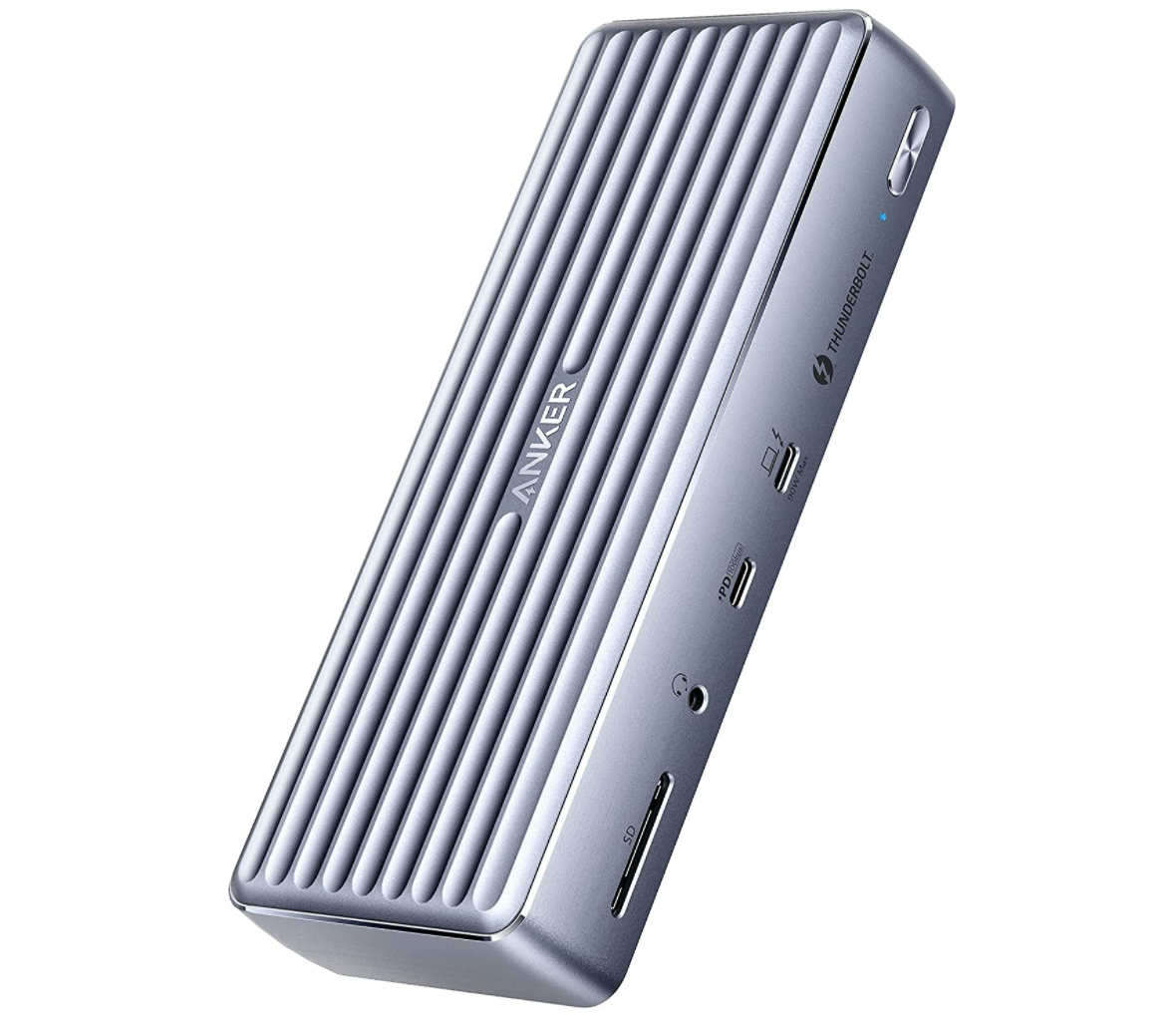
The Apex Thunderbolt 4 Dock features peerless 40Gbps upriver TB4 port (that connects to the computer with the included Thunderbolt 4 cable) and one 40Gbps downstream TB4 port for other devices, such every bit a accelerating SSD computer storage drive. The upstream Thunderbolt port can supply up to 90W of power to your laptop computer, while the downstream port can charge other devices at 15W.
Anker's inclusion of two HDMI ports means you don't involve any adapters to connect displays. In total, the dock supports the ii Thunderbolt 4 ports, two USB-A ports (10Gbps, 4.5W of baron), another two USB-A ports (480Mbps, 4.5W), and a USB-C port (10Gbps, 20W) alongside Gigabit Ethernet, a UHS-II SD card reader and a 3.5mm headphone jack. The dock is powered, with a 120W power issue.
An extra plus is a power clit on the movement so that your laptop isn't receiving a potential mission when it's not needed, and force out keep the dock's temperature belt down at night.
Plugable TBT3-UDC3 Thunderbolt 3 Sorrel
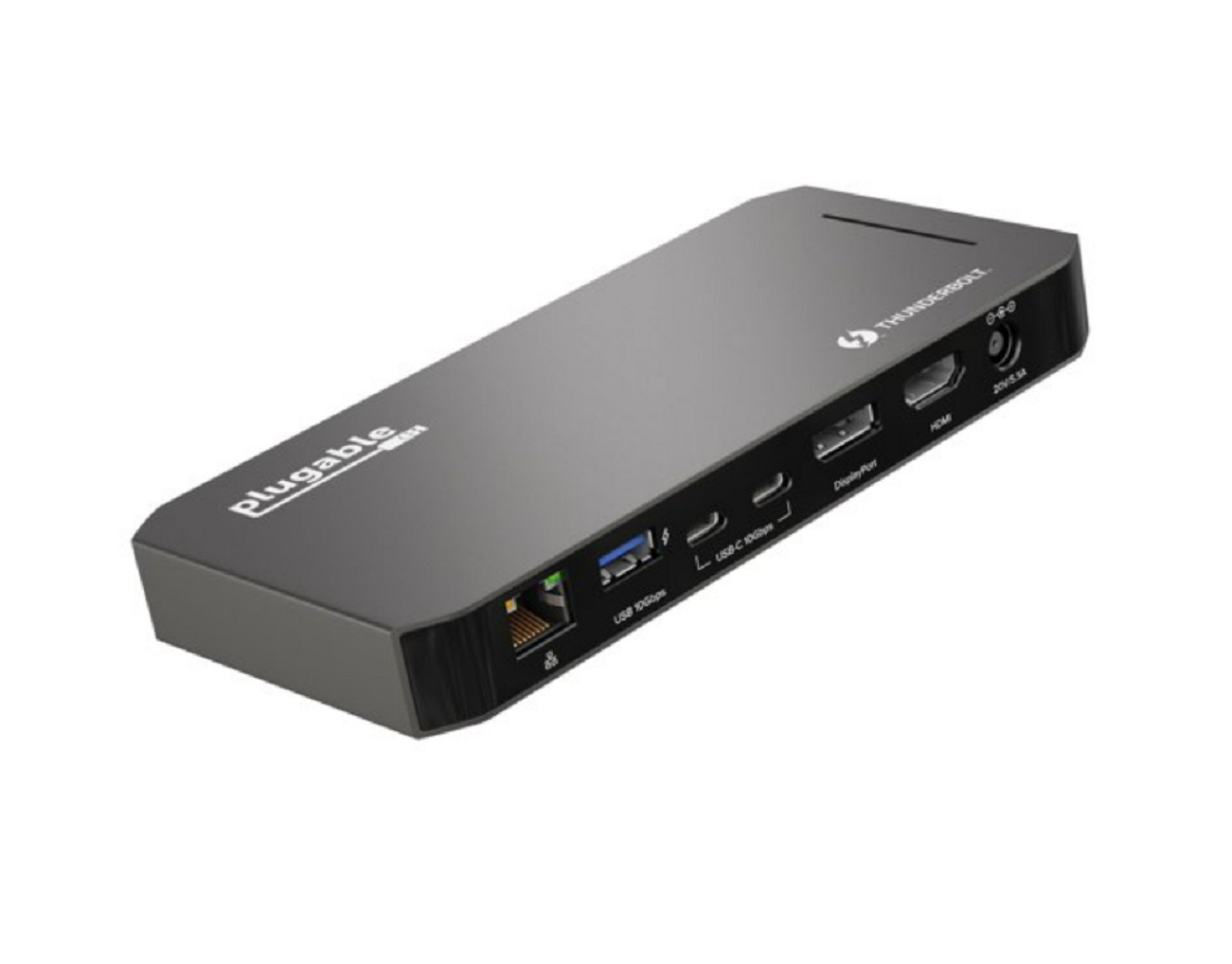
Plugable's TBT3-UDC3 is a littler, to a lesser extent expensive version of the TBT3-UDZ, with less I/O flexibility but much focus. The dock includes a pair of USB-A 5Gbps ports on the head-on for a pussyfoot and keyboard, and then a second USB-A (10Gbps) port on the endorse. A mate of two 10Gbps USB-C ports sit alongside it for further expanding upon. There's Gigabit Ethernet, too. Smartly, Plugable includes peerless HDMI 2.0 embrasure and a DisplayPort 1.4 interface for display connections, plus an HDMI-to-DisplayPort dongle in the box in case you own two HDMI displays.
A 2.6-foot Thunderbolt 3 cable supplies 96W of great power to a laptop, which is excellent.
Execution was on par with the TBT-UDC3, with very little heat emitted from the wharfage. Connected unity occasion the dock stopped working, but resumed operative a second time when we plugged it in a week or thusly later. This seems wish an otherwise excellent sour grass, but we've slightly lowered the evaluation because of this. Plugable includes a two-class warranty in case you receive a high-risk unit.
CalDigit Thunderbolt Station 3 Summation (CalDigit TS3 Plus)
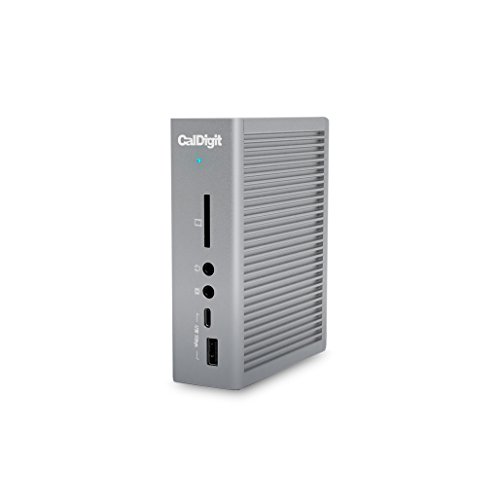
CalDigit's Thunderclap Station 3 Plus is one of the nigh popular Thunderclap 3 docks available, and IT's easy to see wherefore: a place-redeeming hierarchal orientation, 87W charging, gobs of addressable ports, and level niceties care a S/PDIF optical connection and an external Bombshell jack for daisy-chaining devices.
The TS3 Plus measures 5.15 x 3.87 x 1.57 in., and weighs 1.04 pounds. Though it lacks a supporting stand, it rested easily in a vertical position. CalDigit includes immature rubber feet for location the aluminum pier in an horizontal orientation.
Left selection includes: two Thunderbolt 3 ports (one from the laptop, and one for an external connection), and a single DisplayPort 1.2 embrasure. That's perfect for a single 4K display, but awkward for two. The TS3 Plus includes 1 full-sized SD (SD 4.0 UHS-II) tease reader, the S/PDIF porthole, gigabit ethernet, and two 3.5mm audio jacks—matchless in, one outer. Five USB Type A ports are also included (all 5Gbps USB 3.1 Gen 1) and two USB-C ports (one 5Gbps embrasure, and one 10Gbps port).
To enable two 4K/60 displays, you'll need a endorsement USB-C dongle running off either the Thunderbolt or USB-C dock—or a forward-looking display with a built-in Thunderbolt/USB-C connector. These are still rare in the Windows world.
Daisy-chaining the Thunderbolt port to enable a second monitor worked fine, though the connection dropped momentarily on some displays when playing back video on both displays and transferring files. Otherwise, high-pitched-bandwidth TV playback went completely swimmingly. The external sound jack also didn't work initially, merely did on a subsequent retry. CalDigit's TS3 Plus scarcely warmed nether onus.
Other Thunderbolt docks we tested
Your Bombshell dock choices extend far beyond what we've suggested. Hubs mix and tally unlike port types, and different chassis factors. Pay attention to our ratings, prices, and the quirks of each to find an option that fits your limited needs.
Bombshell 3 Mini Dock (Dual HDMI 2.0) (TB3-MiniDock-HM)
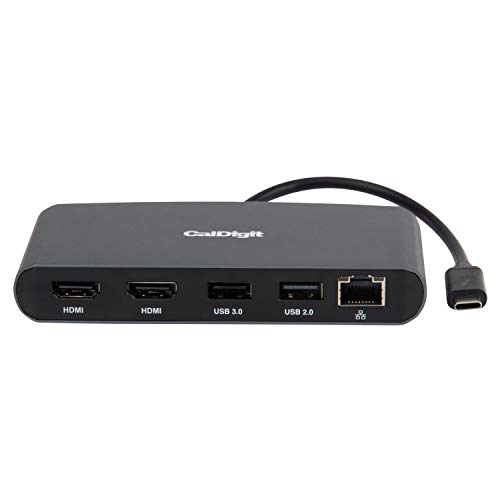
Out of the box, the CalDigit Thunderbolt 3 Mini Dock (Twofold HDMI 2.) seems apotheosis for a resolve-built, bus topology-powered Thunderbolt dockage: instead inexpensive, with just the ports you'll need and not much else.
The version we reviewed ships with gigabit ethernet, a pair of USB Typewrite-A ports (USB 3 and USB 2) and two HDMI 2.0 ports. A shortish 5.3-inch Bombshell 3 cable connects the bus-power-driven TB3-MiniDock-HM to your laptop computer. Remember, "bus-battery-powered" means that you don't need a charging brick, saving space.
Our test laptop began unexpectedly reportage glitches, however, including visual errors on some displays and the unfitness of the laptop to read USB drives or colligate to a USB sneak away—until we ascertained that the power cable length had worked unaffixed. CalDigit diagnosed the problem as our laptop's unfitness to supply the requisite 15W of power for the Mini Dock to function appropriately. (The Miniskirt Dock does not include a charging interface, and we've seen other users complain approximately the USB-A issue.) The Mini Dock again worked when we attached the laptop computer's charger, but later on failed to recognize an external USB drive. It seems like not enough power is consistently passing through the USB-A ports, supported our tests with a USB-C power meter. We tested the dock connected a second Bombshell-powered laptop and received the like result.
Performance-sapient, the Thunderbolt 3 Mini Dock performed well, though with numerous frames dropped happening our two 4K/60Hz test videos. Heat was never an publication.
Kensington SD5700T Thunderbolt 4 Docking Station
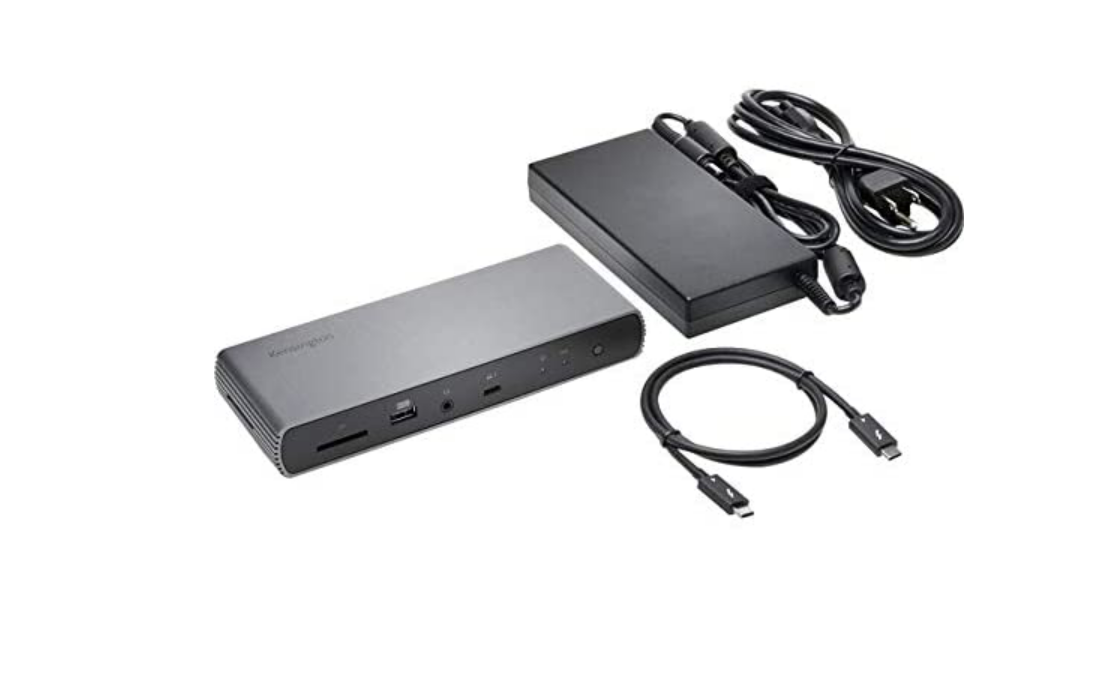
We truly liked the shape of the SD5700T, just the price is a little daunting given the strong competition.
The Kensington SD5700T Thunderbolt 4 Moorage Station has unmatched upstream Thunderbolt 4/USB4 port to connect to your figurer, and three downstream Bolt of lightning 4/USB4 ports to connect other devices, including external displays. In addition, the dock supplies tierce USB-A ports (10Gbps, charging at 4.5W) and a single USB-A porthole (480Mbps) that can charge at 7.5W. In addition, the SD5700T provides Gigabit Ethernet, a UHS-II SD card reader, and a 3.5mm audio jack. The dock is powered by a rather powerful 180W power supply., among the highest we've tested. This should provide plenty of power for connected devices.
We also love the lights that show power and connectivity status, plus the Connected/Off button that wish relieve strain on your connected laptop's battery.
OWC Bombshell Sour grass (OWCTB4DOCK)
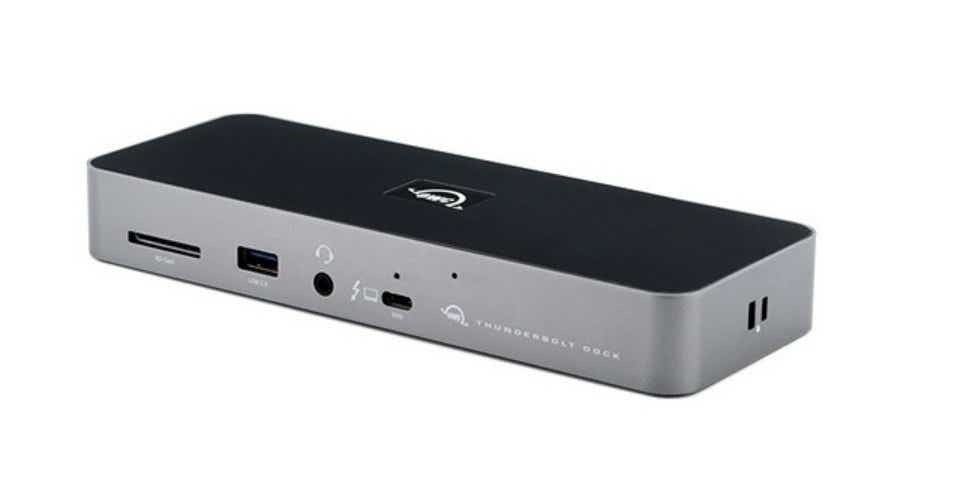
The big brother to OWC's Thunderbolt Hub, the OWC Thunderbolt Dock provides three Bombshell 3 ports for Bolt devices, advantageous three USB-A 10Gbps ports, one USB-A 2.0 charging port, an Coyote State (UHS-II) card slot, gigabit Ethernet, and an audio jack.
Like its small sibling, this is a specialty dock is designed for those who have invested in Thunderbolt displays and other Thunderbolt devices. Thither are no external show connections besides the Thunderbolt interface. The Dock measures 7.8in. x 2.9in. x 1.0in. and 14.1oz. The included Bolt 4 cable measures about 2.5 feet.
Like the OWC Thunderbolt Hub, the Wharf supports direct connections to Thunderbolt displays and devices, including a pair of 4K/60 displays. (The Dock supports DisplayPort 1.4.) If you connect another Thunderbolt dock to one of the Thunderbolt 3 outputs, however, only one 4K/60 display will be enabled. Directly connected, a Thunderbolt 4 drive wrote information at 1,221 MB/s and read at 2,292 Megabyte/s. Wired to the Loading dock, it wrote at 1027 MB/s and wrote at 2210MB/s. An South Dakota bill located inside the Sour grass read and wrote data at speeds comparable to an SD card slot built into Microsoft's Surface Book 4 laptop.
OWC says that the Wharfage supplies capable 90W for charging the host laptop. OWC doesn't define the charging capabilities of the "charging" USB 2.0 Type A port, but we measured information technology at more or less 7W, enough to charge, but not fast-charge, a OnePlus smartphone. The Dock remained absolutely cool to the touch under load.
Sonnet Technologies Echo 11 Thunderbolt 4 Dock
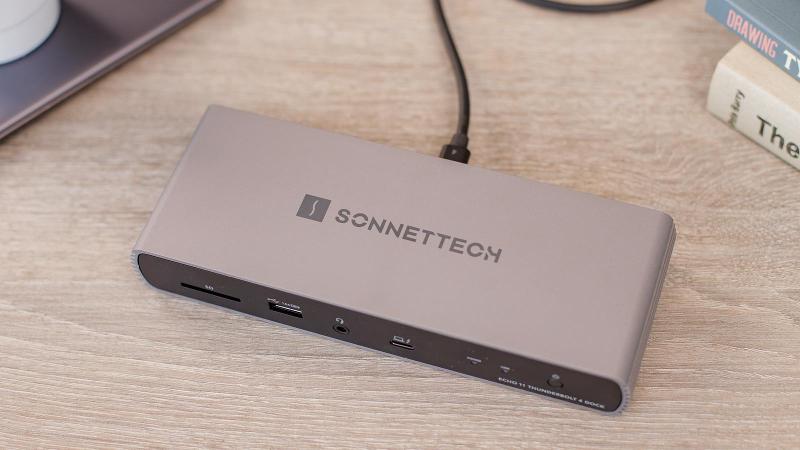
Straddling the definition between "wharf" and "hub," the Sonnettech Echo 11 includes three downstream Thunderbolt 4 ports, plus the Thunderbolt 4 input signal left to your laptop. But there are three fastened 10Gbps USB-A ports (USB 3.2 Gen 2) for connecting older devices – apiece supplying 7.5W of power. There's also a USB-A port along the front of the dock, but information technology's a underweight USB 2.0 port that offers fair 480Mbps information transfer but pot shoot up at 7.5W. The Echo 11 can mogul a affiliated laptop at up to 90W. Information technology draws 135W via an external power add.
Merely wait! The Replication 11 also includes an SD card reader (SD 4.0 UHS-II), Gigabit Ethernet, arsenic symptomless every bit a 3.5mm audio jack.
We'd prefer to see the Echo 11 offer display ports as well, which is why we father't include it in our advisable offerings. Still, if you own a external display with a Thunderbolt input, the Echo 11 will work just fine.
Thunderbolt wharf buyer's guide
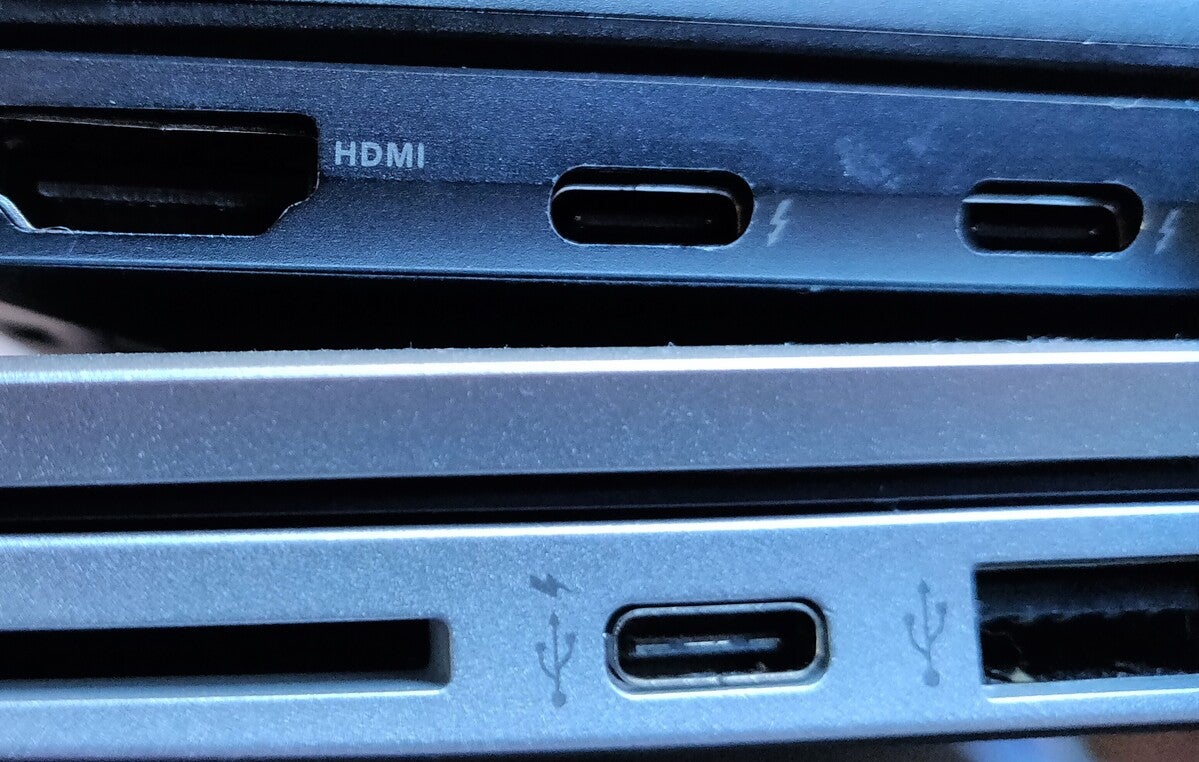
Two laptops, both with USB-C ports, and both with lightning-bolt symbols. Which laptop computer offers Thunderbolt? The top one, though it can be difficult to tell. Consulting the manufacturing specifications is your safest bet.
If you're connected the fence around whether a Thunderbolt dock is right for you, knowing the answers to the undermentioned questions could aid you.
How do I know if my laptop has Thunderbolt?
The momentary answer: Consider the laptop's published specifications to be sure. A Bombshell port may flavour identical from a USB-C port, since they some use the same sensual USB-C connection. Put another way, all Thunderbolt ports are USB-C, but not wholly USB-C ports are Thunderbolt-equipped.
Thunderbolt ports aresupposed to have a small lightning-bolt ikon to identify them. But approximately laptop makers use a akin lightning-bolt image to indicate that a USB-C embrasure can be used for charging your phone, andnon for Thunderbolt. Laptop makers sometimes Don't want to clutter the clean lines of their products by adding extra logos, IT seems.
Adding to the mental confusion, you may also see USB-C hubs marketed as "Thunderbolt compatible." That's true. You can male plug a Thunderbolt loading dock into a non-Thunderbolt, generic USB-C larboard. But it will be limited by the available bandwidth that the port provides, so it's somewhat deceptive in this regard.
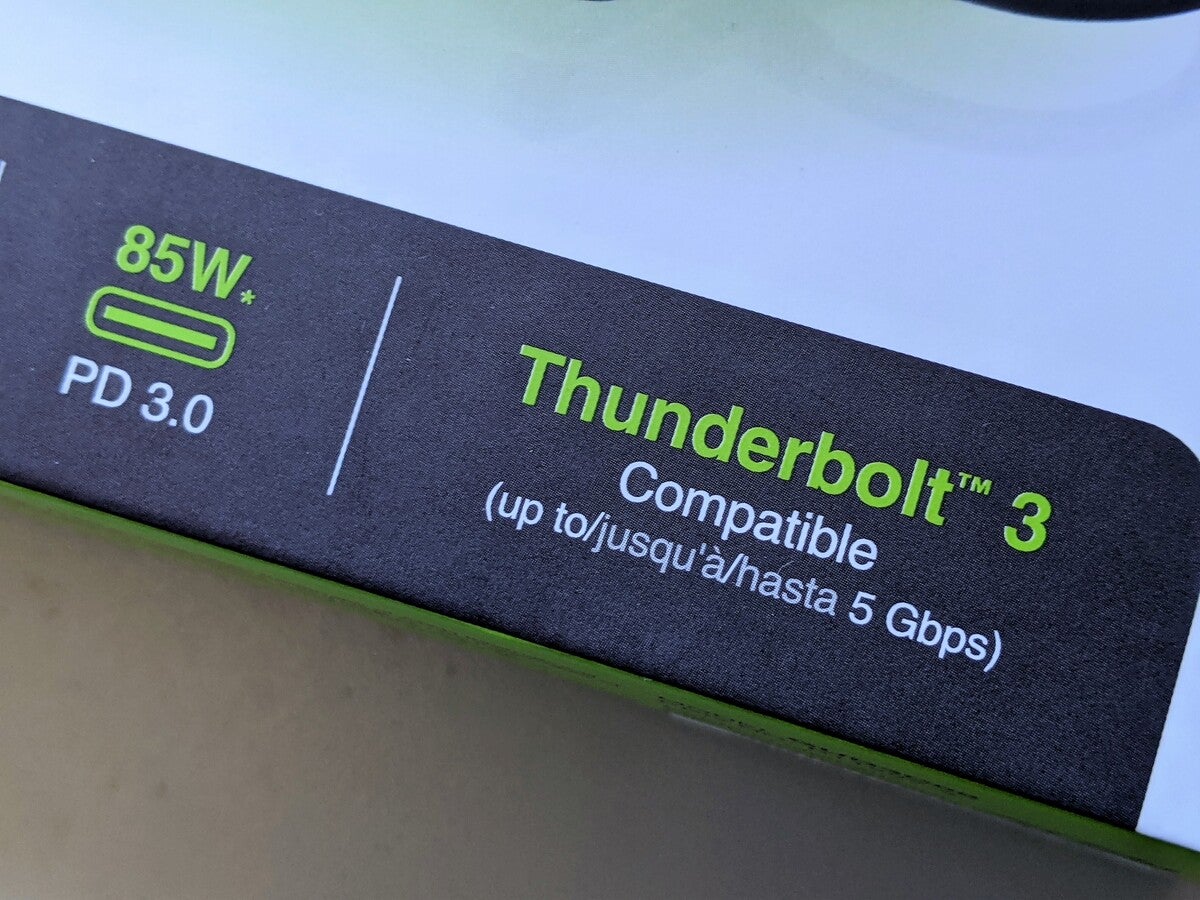
A Thunderbolt 3 "compatible" dock is non a true Thunderbolt dock, but a USB-C hub. The tipoff here is the 5Gbps throughput.
How fast is Thunderbolt?
Almost USB-C ports are made-up on the second-generation USB 3.1 data-transfer standard, which transfers data at 10Gbps. Most Thunderbolt 3 ports, the most common standard, transfer data at busy 40Gbps. Thunderbolt 4 differs slightly in that IT supports a a priori maximum of 32Gbps where data transfers are concerned, specifically for external repositing devices.
There are somewhat rare exceptions: A new USB 3.2 Gen 2X2 spec commode geminate two 10Gbps channels together, creating an aggregate 20Gbps hub. And while the vast absolute majority of Thunderbolt 3-equipped laptops are designed with four PCIe lanes for a number of 40Gbps, some laptops only ship with deuce PCIe lanes for a total of 20Gbps. (A Dell support page, for example, details its four-lane and two-lane laptops.) Fundamentally, a 20Gbps connection should be enough for a one-member 4K ride herd on running at 60Hz, with a trifle of extra bandwidth for other data transfers among connected peripherals.
What's the difference betwixt Thunderbolt 3, Thunderbolt 4, and USB4?
The short answer: Non that practically, and we consider Thunderbolt 3 docks and Bolt 4 docks to be functionally equivalent for most users. The longer answer, which we'll describe under, is that there are differences, and parsing the nuances can be confusing. Think of Thunderbolt 4 as the more restrictive translation of Thunderbolt 3, with little room for whatsoever gotchas.
In essence, Bolt 3 and Thunderbolt 4 allow busy 40Gbps maximum bandwidth, enough for two 4K/60 displays. "Up to" is the of import phrase: Thunderbolt 3 is only needed to financial support a 10Gbps connection, allowing for a single external 4K display (a 16 Gbps PCIe connection, matched with USB3.2). Most manufacturers go on the far side this, however, and our recommended docks support the fraught stipulation (and two 4K displays) unless noted. Thunderbolt 3 also supports a slower (16Gbps) PCIe connection for connecting to international storage. Unless you're editing video or using an external GPU, this probably won't matter.
Thunderbolt 4 doesn't admit for any leeway — you're getting a full-fledged 40Gbps connection (32 Gbps PCIe + USB 3.2), no questions asked. For external storage, Thunderbolt 4 supports 32 Gbps of data transpose — again, this really only matters for video, external GPU connections, or perhaps games. Thunderbolt 4 supports "backwash happening sleep" from an external keyboard or black eye, which allows you to tap your outer keyboard or joggle your mouse to wake your PC up, which is handy. Thunderbolt 4 allows for yearner cables and more Thunderbolt ports on laptops, too.
USB4 is essentially a subset of Thunderclap 4, primarily designed as an an I/O specification. USB4 can only support one display, and manufacturers can choose whether it supports a 20Gbps connective OR a 40Gbps connection, according to Bolt of lightning dock designer Plugable. Every bit a subset of Thunderbolt 4, a USB4 gimmick will run just fine plugged into a Bombshell 4 port. Simply a Bolt 4 twist may not work as expected when plugged into what is specifically a USB4 port. Don't care about this also much, as it's rare to see a USB4 hub. Instead, most hubs and docks are marketed arsenic Thunderbolt 4, while most devices (like an extrinsic SSD) are studied around USB4.
Note of hand that Thunderbolt 3 and 4 necessitate leastways 15W to power devices plugged into the Thunderbolt port, much as a busbar-powered disk drive. USB4 requires honourable half that.
Device maker Anker has a nice summary of all of the technical features associated with Thunderbolt 3, Bolt of lightning 4, and USB4, if you really want to assume the fine distinctions.
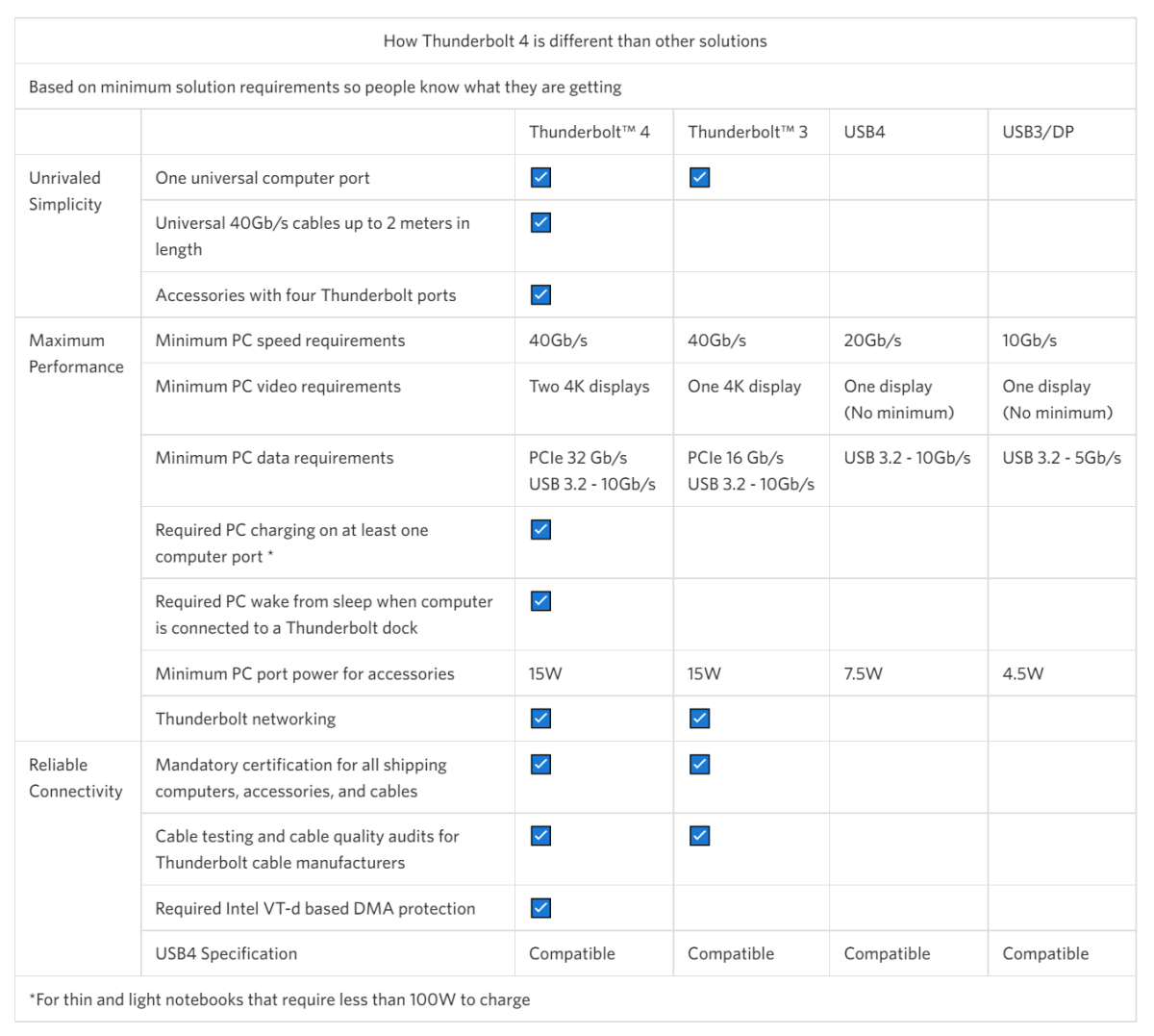
Thunderbolt dock and I/O hub designer Anker provided this compendious of the differences 'tween Bolt of lightning 3 and Thunderbolt 4.
Anker
Well-nigh every Thunderbolt twist will ship with its own cable. We'd recommend that you use Thunderbolt 3 cables with Thunderbolt 3 products, and Bolt of lightning 4 cables with Bolt 4 products.
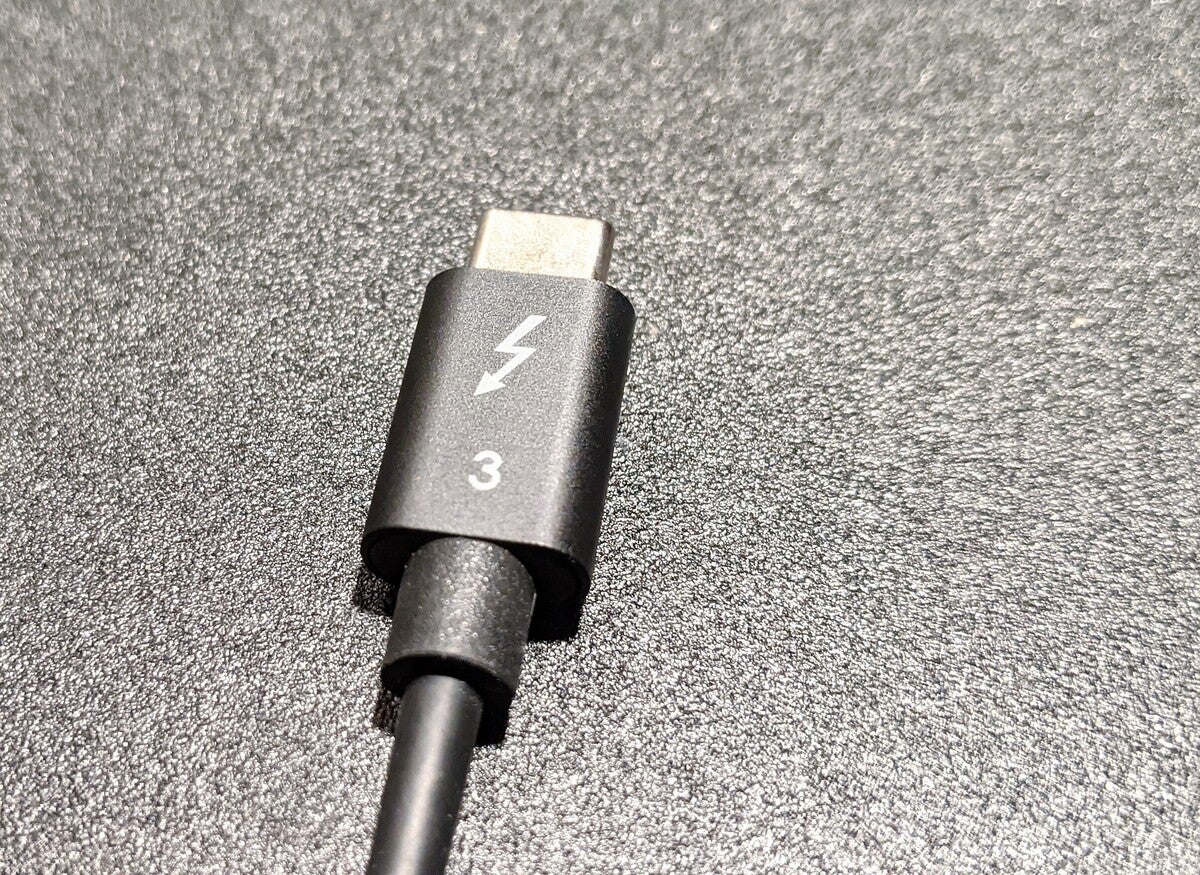
The large majority of Thunderbolt docks should include a Thunderbolt cable like this unmatchable, which indicates that it's nominative for Bolt of lightning 3.
What to take care for in a Thunderbolt dock
Ports, cables, peripherals: Those are the three major considerations when buying a Bolt dock.
We're beginning to meet the Bolt of lightning dock market break weak into a few different ways. First, at that place's the budget versus riddled-featured docks we've highlighted to a higher place. But you also English hawthorn see something similar to the old USB hubs of gray, too: Devices that take Thunderbolt in and then leave different USB-C (including Thunderbolt) ports out. There are a small number of displays with Bombshell inputs, which can be blocked like a shot into these hubs. Do you have got an existing cheap USB-C dongle? You nates certainly plug that in into a Thunderbolt dock and add even to a greater extent I/O functionality.
Basically, consider what you'll want to plug into the wharf as a pathfinder for buying one. We prefer devices with ports built in (such as HDMI, USB-A, and sol on) every bit the USB-C device ecosystem is still in its early childhood. But ask yourself some questions. Do you want a basic Thunderbolt dock, with just a dyad of HDMI ports for conjunctive two displays? Does an SD card slot matter? How many USB Type A peripherals do you plan to attach? Act you deficiency to use the Bombshell cable television service to lodge your laptop, too?
Cables can be an unexpectedly important thoughtfulness, too. Virtually every loading dock ships with a Thunderbolt cable. But consider the displays you own (typically HDMI surgery DisplayPort) and consider whether the dock will accommodate them.
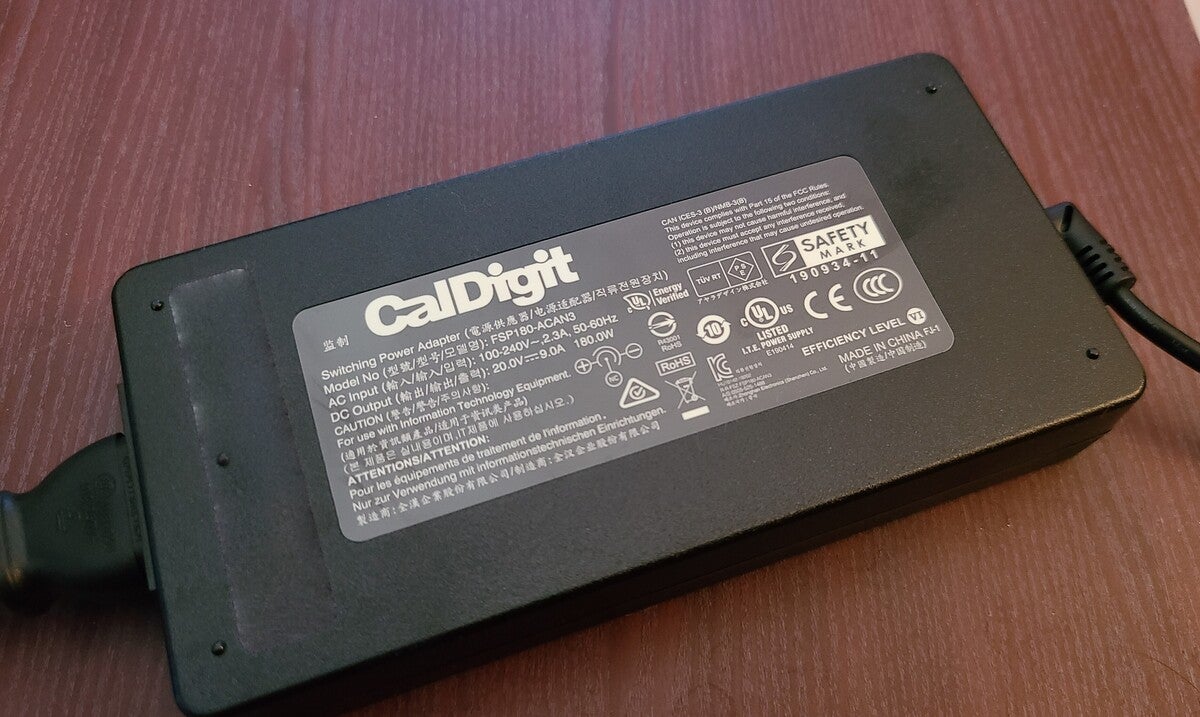
Supercharged Thunderbolt docks, especially those that power your laptop, can ship with some pretty sizeable power bricks.
Check your laptop computer's power supply. Does it plug into your laptop via USB-C? If thusly, a Thunderbolt dock wish likely power it. You'll need to understand how the dock supplies powerfulness, though. Check your laptop computer's charger to learn how much exponent it supplies, and how much the dock will need to append to replace it. If your laptop or devices aren't receiving enough magnate, you may catch a warning pop upbound.
A "bus-battery-powered" dock won't accompany an external charger in the package, saving some cost, quad, and tycoo concerns. A dock with "power livery" wish supply its own powerand charge your laptop and/or a earpiece via your laptop's existing USB-C charger. (Chances are that it won't offer the prompt-charging capabilities premium smartphones offer, though.) The more power your dockage supplies, the greater the power to commission your laptop and any bus-powered devices. This is a gotcha most people don't think about, sol if you contrive to relate several bus-powered hard drives or SSDs, buy a dock with a goodly superpowe supply. (USB keys, on the other hand, require tiny amounts of power. Don't trouble about these.)
Thither's one more thoughtfulness: the length of the Thunderbolt cable between your laptop and the dock itself. You English hawthorn have detected or heard about USB-C ports wearing out on smartphones; a loose or Wobbly connector happening Bolt of lightning docks can cause monitors to unexpectedly flicker operating theater lose connection. Deal how some tautness will be put along a cable. A Thunderbolt bobtail that's dangling from a Thunderbolt interface will stress the physical connector. You don't lack that!
If you're a Mac substance abuser who has stumbled across this article, welcome. But delight be aware that early Apple MacBook Pros powered by Intel Si supported up to two 4K displays. The first MacBook Pros powered by the Apple M1 chip only support a divorced 4K display. Many Mac users have recently left negative reviews on Thunderbolt docks happening shopping sites because of this. Bargain a PC!
How we tried
We're working from the premise that you're purchasing a Thunderbolt dock for its single power to connect to two 4K monitors at 60Hz. Lower resolutions should be much easier to run with success. Our best examination simply connected each dock to a pair of 4K/60Hz displays, each of which could accept DisplayPort and HDMI cabling, and made sure on that point were no visual artifacts at 60Hz resolution.
Ordinal, we checked to encounter whether the in stock ports delivered the bandwidth we'd look, connecting them to an external SSD and transferring a collection of test files over the Thunderclap wire and port wine. We also used AJA's Scheme Test tool to double-check our numbers and test whether say and write out speeds were consistent.
Finally, we spot-checked the available power draw up of the hubs and ports with a USB power meter, likewise as simply connecting them to bus-power-driven devices to see to it if they could deliver enough power to allow them to operate. Present, we discovered that one of our testing laptops didn't issue plenty power running on battery to power a bus-powered Thunderbolt dock, thus we enlisted a second, diverse laptop computer as a backup.
This floor was updated on November 18, 2021 with new information and cartesian product recommendations. Some of our recommendations are based on Thunderbolt dock reviews produced away our sister site, TechAdvisor.co.uk, and authored by Simon Jary.
Note: When you purchase something later clicking golf links in our articles, we may earn a small commission. Study our affiliate link insurance for more details.
As PCWorld's senior editor, Mark focuses on Microsoft news program and chip technology, among other beats. He has at one time written for PCMag, BYTE, Slashdot, eWEEK, and ReadWrite.
Source: https://www.pcworld.com/article/393714/best-thunderbolt-docks-for-a-laptop-pc.html
Posted by: penningtonjusnis.blogspot.com
0 Response to "Best Thunderbolt docks for your laptop - penningtonjusnis"
Post a Comment